What is the difference between my personal “Information” and my personal “Data”?
Your Information:
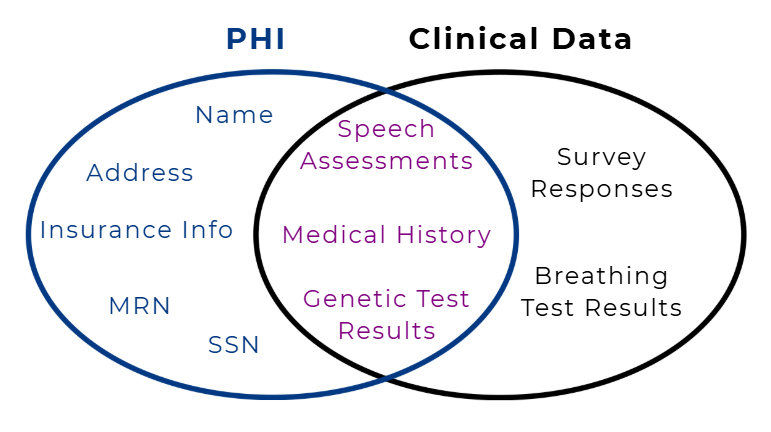
Your personal “information”, also known as your PHI (personal health information), is information that can be used to identify you and is collected for the sake of healthcare or medical-related services. Ex:
Name
Address
Social Security Number (SSN)
Credit Card
Number
Your Data:
Your personal “data” is collected clinical information that can be analyzed to assess your health and its related circumstances or to conduct research. Examples of clinical data that is collected to assessyour health are your:
Breathing Test Results
ALS Symptom Questionnaires
An example of clinical data that is collected to assess the circumstances of your health is:
Environmental Survey Responses
Can my information be both PHI and Clinical Data?
Yes. Some information is considered both PHI and clinical data, as it is collected to assess your health or conduct research, but it could potentially be used to identify you. Ex:
Zip Code
Medical History
Voice Recordings
Genetic-Testing Results
How will my Clinical Data & Biological Samples be kept confidential and secure?
To maintain the confidentiality of your data, your PHI will be intentionally separated from your clinical data and biological samples by using technologies called GUID and NeuroSTAMP. These technologies use some of your PHI to create unique, encrypted 12-character codes that act as irreversible, unidentifiable IDs. Both MGH and NIH have access to the PHI necessary to create these IDs.
Once these GUIDs and NeuroSTAMPs are connected to your data and biosamples, most of your PHI can be removed from your data and biosamples and your data’s security and confidentiality can be maintained. Going forward, the unique IDs act as the link between data sets, allowing for researchers to relate your information and biosamples from different visits and even different research studies to 1 participant.
Where will my PHI & Clinical Data be stored?
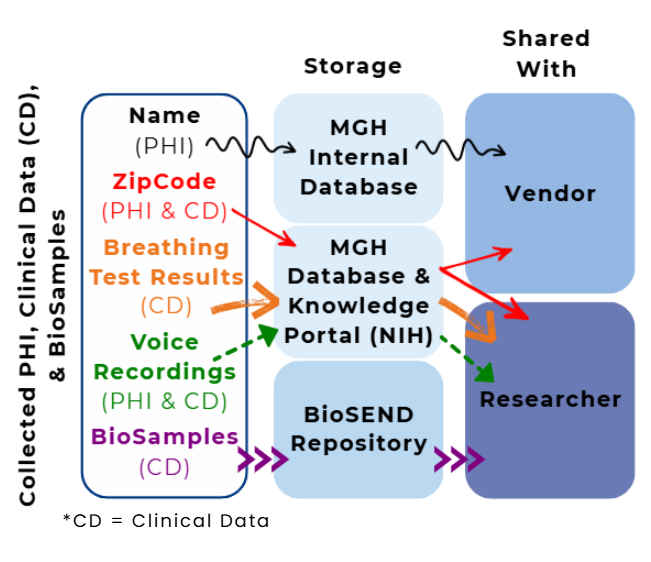
Some of your PHI and all of your clinical data will be stored in 2 databases:
MGH Data Coordinating Center Database: an internal ALL ALS database.
ALS Knowledge Portal: a large external database that is managed by the governmental health and research entity known as the National Institutes of Health (NIH).
Although some of your PHI will be removed from the set of information stored in these databases, other PHI will be entered in both platforms, including your birth date, medical history, and the speech assessment voice recordings.
Where will my Biological Samples be stored?
Your biosamples will be stored in a secure, centralized location run by the NIH at Indiana University, called the BioSEND Biorepository.
Who is ALL ALS sharing my PHI, Clinical Data, and Biological Samples with?
The MGH Data Coordinating Center Database and ALS Knowledge Portal are sharing your information with external parties, including vendors and researchers.
Vendors are the companies that ALL ALS has contracted with to complete and maintain required study activities, including the teams behind the Speech Vitals app (the speech assessment app), the NeuroPRO surveys (digital surveys database), genetic-testing, and the home blood-draw service.
Interested researchers can obtain certain PHI elements, such as your zip code, as well as your clinical data and biosamples under strict approval processes and data-sharing and material-transfer agreements.
If you wish for a member of the study team to contact you about the ALL ALS Consortium, please click the button below: